Video Wall or Large TV? What You Need to Know Before Deciding
Find Out Why Buying A Bigger TV Isn’t Always the Great Solution You Thought It Would Be
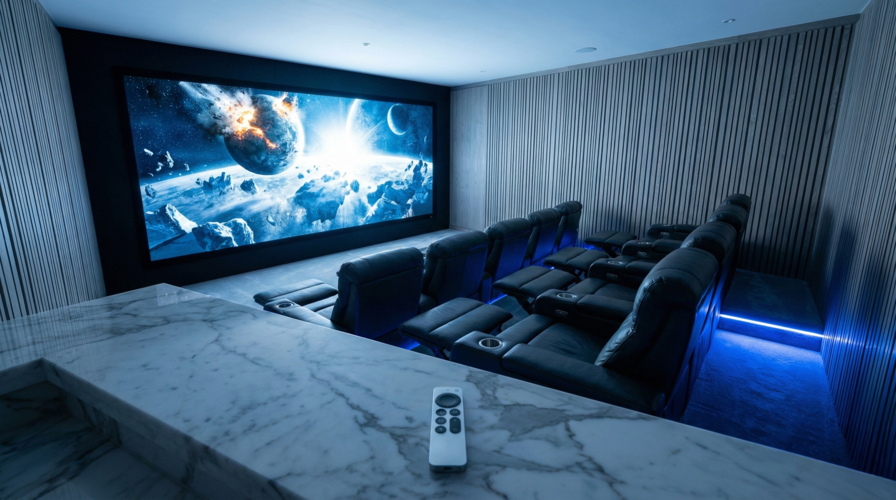
Manufacturers keep pushing screen sizes beyond 100 inches, and it's tempting to assume that the largest option in the showroom is the best selection for your media room. But a large panel TV that size is heavy, hard to service if something fails, and it’s locked into one static dimension. Once a room is bright, open, or larger than a standard theater, a traditional TV can start to feel undersized in the space rather than impressive.
A bigger screen isn't automatically the right screen for your home entertainment. Video walls and big-screen TVs solve different problems, and the room you're putting one in usually determines which is the smarter fit.
Keep reading to learn what actually separates the two, and where each one belongs.
SEE ALSO: Get Started on Your Top-Tier Home Theater Design
What Separates A Video Wall From A TV?
A video wall is built from individual tiles, so think of it the way you'd think about tile flooring versus a single area rug. A rug comes in one size, and you either find a room that fits it, or you live with the gap. Tile is set piece by piece, so it fills the room exactly, and if one section gets damaged, you replace that section, not the whole floor. A video wall works the same way, while a traditional TV works like the rug.
A video wall isn't just one panel; it's a grid of smaller, modular tiles assembled into a single, bezel-free image. The modular build is the whole advantage: a video wall can be sized to fit practically any room, from a modest media nook to a two-story-high great room, instead of forcing the room to fit a fixed screen size. If one module ever needs service, a technician replaces that section rather than the entire display. The takeaway for your home: the room dictates the size, not a manufacturer's spec sheet.
Where A Traditional TV Still Wins
For a dedicated theater in the 65- to 85-inch range, a high-end TV remains the simpler, more cost-effective choice. It still delivers sharp, cinematic picture quality at a fraction of the cost of a custom video wall, and it suits the space just fine for premium entertainment experiences. If your room is already sized for a standard screen and light control isn't an issue, there's rarely a reason to go bigger just because the technology exists.
Where A Video Wall Earns Its Keep
While video walls will look great in dark cinema rooms, they really hold their own in bright, open living spaces where a conventional TV screen would need to compete with daylight. Because the display is built from individually lit modules, brightness and contrast hold up even with ambient natural light, and there's no burn-in risk from static images, as there can be with some other display types. That makes a video wall a realistic option for a great room or bar area, not just a windowless dedicated theater. Every component is tested in-house before it ever reaches your home, so what shows up on install day is already confirmed to work as one system.
Does Leasing Make This Easier?
Display technology keeps advancing quickly, and a video wall purchased outright can start to feel dated well before it wears out. Since Total Home Technologies leases the majority of its systems rather than selling them outright, you can upgrade to a newer display or AV system down the road instead of living with equipment that's fallen behind, without the burden of unloading an aging setup yourself.
Not sure whether your space calls for a video wall or a large-screen TV? Visit our showroom and see both side by side before you decide. Request a personalized showroom visit here.